![Ozen Long - Back (1)-2.png]](https://support.ozeninc.com/hs-fs/hubfs/Ozen%20Long%20-%20Back%20(1)-2.png?height=50&name=Ozen%20Long%20-%20Back%20(1)-2.png)
In Motor-CAD’s electromagnetic field formulation, eddy-current-carrying regions are governed by the magnetic diffusion equation:

where:
|
Symbol |
Description |
|
𝐀 |
Magnetic vector potential (B=∇×A𝐁=∇×𝐀) |
|
𝜇 |
Magnetic permeability |
|
𝜎 |
Electrical conductivity |
|
𝐯 |
Local linear velocity (v=ω×r𝐯=𝝎×𝐫) |
|
𝐁𝐫 |
Remanent flux density (non-zero for PMs, zero for unmagnetized metals) |
- The motion-induced term σ(v×∇×A)𝜎(𝐯×∇×𝐀) applies only to rotating components (e.g., the rotor).
- For stationary conductive parts (e.g., the stator), this term is omitted.
B. Induced Current Density and Eddy-Current Losses
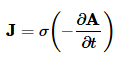
From the time-varying magnetic vector potential, the induced current density is given by:
J=σ(−∂A∂t)𝐉=𝜎(−∂𝐀∂t)
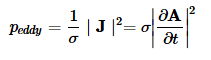
The corresponding eddy-current power loss density (power dissipated per unit volume) is:
Motor-CAD’s transient electromagnetic solver enforces the zero-net-current condition for each conductive region:

This ensures physical current continuity—particularly important for circumferentially segmented magnets, where localized eddy loops must sum to zero across the entire segment.
C. 2D-to-3D Correction Factors
Because Motor-CAD’s electromagnetic model is two-dimensional, axial effects are incorporated through an empirical 2D–3D correction factor, k2D3Dk2D3D. Three methods are available depending on the operating frequency and magnet dimensions:
1. Ruoho Method — Low-Frequency Validity
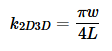
Used when the magnet width w is smaller than the skin depth δ.
Applicable for low-frequency operation.
2. Wakao–Fujiwara Method — High-Frequency Validity
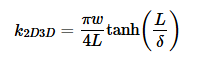
Used when w>δ, i.e., high-frequency conditions.
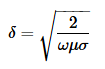
Here, the skin depth is calculated as:
3. Hybrid Method —Full-Frequency Range
Motor-CAD automatically transitions between Ruoho and Wakao–Fujiwara methods based on the ratio w/δ, ensuring accuracy across both low and high frequency regimes.
Notes:
- For V-shaped magnets, use the width of the magnet layer closest to the rotor surface (highest eddy-current loss region).
- For U-shaped magnets, use the average magnet width.
Motor-CAD applies the same Ruoho-based correction to compute losses in rotor banding and stator sleeves:
|
Component |
Width (w) |
Axial Length (L) |
|
Rotor banding |
Pole width |
Magnet axial segment length |
|
Stator sleeve |
Pole width |
k×Lstator+Lend overhang |
where k is the sleeve axial length multiplier.
References
- Ruoho et al., “Modeling Magnet Length in 2-D Finite-Element Analysis of Electric Machines,” IEEE Transactions on Magnetics, 2009.
- S. Wakao et al., “Useful Formulas of Analytical Investigation in Electromagnetic Field Computation (Part 6),” IEE Japan, 2005.