![Ozen Long - Back (1)-2.png]](https://support.ozeninc.com/hs-fs/hubfs/Ozen%20Long%20-%20Back%20(1)-2.png?height=50&name=Ozen%20Long%20-%20Back%20(1)-2.png)
In this article the Courant–Friedrichs–Lewy condition (CFL condition), or Courant number criterion will be described. For the calculation of the time step, a characteristic length and the maximum velocity are required. Although the description below is for Fluent, this method can be extended to other tools.
Answer
1-The CFL condition states that the time step is given by,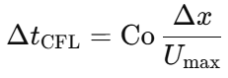
Where:
Co = Courant Number
Δx = Characteristic length [m]
Umax = Maximum velocity in the domain [m/s]
2-Courant Number
- For explicit schemes, stability requires Co < 1 (often 0.1–0.5 is chosen for accuracy)
- For implicit schemes, you can allow Co > 1 for stability, but accuracy usually requires Co = 0.1–1, depending on how much you want to resolve the transient scales.
3-Characteristic Length
Find the smallest cell volume in your mesh (Vmin).
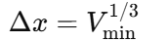
In Fluent, go to Domain > Check > Perform Mesh Check

4-Find the maximum velocity in the simulation (Umax)
- If you know the inlet velocity, be aware that the maximum velocity might be higher depending on the geometry and flow patterns.
- Create a contour plot that includes all bodies
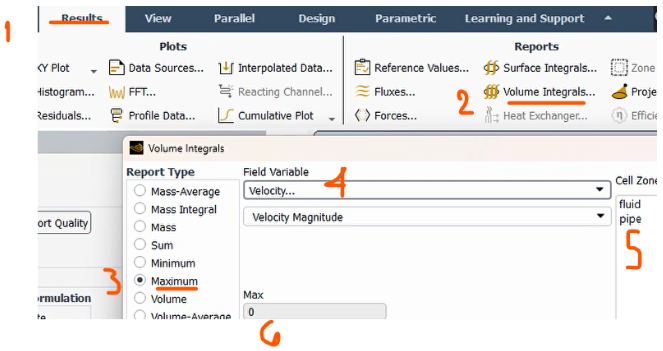
- Go to the 'Results Tab' (1) > Volume integrals (2) > Select max (3) > Select velocity (4) > Select your domain (5), and compute > The result will be shown (6)
5- Example
Vmin = 1-9e-12 m3
Δx = (Vmin)^(1/3) = 1.24e-4 m
Vmax = 10.3 m/s
Co = 1
Time Step = 1.2 e-5 s